In the intensely competitive realm of modern serious oversteer competition, victory is not merely purely a product of sheer torque or behind-the-wheel aggression. Instead, it is now a complex engineering challenge which demands a painstaking blend of selecting a time-tested car, arming it with the highest-quality drift-spec components, and, most importantly, comprehending its live behavior on the course through sophisticated vehicle dynamics analysis tools. This comprehensive handbook acts as your roadmap starting from the very first idea of a drift build all the way to the last data-informed tweaks that turn a capable vehicle into a repeatable podium finisher. We will delve deep into the precise engineering of car suspension tuning, showing how a advanced vehicle dynamics tool like a dedicated telemetry system eliminates approximation and delivers unparalleled insight into your car's real-world dynamics.
The bedrock of any great drift machine is, without question, the platform itself. Certain cars have earned renowned standing within the international drifting scene due to their built-in balance, durable design, and the enormous ecosystem of specialist components available. Choosing the correct platform is the primary and most significant selection a builder will make. For instance, the BMW E36 is widely regarded as one of the finest overall cars for drifting of the modern era. Its near-perfect balanced front-to-rear weight, alongside a RWD layout and robust straight-six powerplants, establishes a car that is simultaneously forgiving for newcomers and highly effective in the possession of a professional competitor. The next step of this lineage, the BMW E46 platform, builds upon these attributes with a increasingly refined chassis, broader wheel track for improved high-speed stability, and still a greater degree of turning capability as standard from the OEM. Another dominant contender in the professional circuit is the Corvette C6.
This American performance car brings a distinctive set of strengths to the sliding discipline, including a lightweight aluminum chassis, a backwards-positioned drivetrain component that contributes to an perfect front-to-rear mass ratio, and the tremendous low-end power of a big LS-series V8 engine. This combination renders it an absolute weapon on track, capable of starting and maintaining extended drifts with apparently easy application of acceleration. For builders looking for exceptional value, the 350Z model Nissan rises above as a top-tier choice. It is delivered from the factory with a rigid platform, a effective factory limited-slip differential, and the free-revving V6 motor that delivers ample horsepower and torque for mastering and progressing in the discipline. Its newer version, the 370Z model, brings further advancements in structural rigidity, suspension design, and peak motor power, establishing its place as a popular pick among competitive pilots. Additional legendary platforms that deserve attention encompass the lightweight Wankel-engined Mazda FC RX-7, the ever-present Nissan S13 240SX, the American SN95 generation Mustang, the electronic-equipped BMW E90, and the tiny yet surprisingly engaging and teachable Mazda Miata. Each of these chassis gives a unique palette of attributes, complexities, and capabilities, but they all possess the core components essential to become a serious sliding vehicle.
However, picking the correct car is only the starting point. To unlock the full performance of every of these cars, major changes to the steering and suspension systems are absolutely mandatory. This is where the domain of performance aftermarket parts enters critical view. The one most impactful improvement for a serious drift car is the installation of a maximum-angle steering angle kit. These engineered systems, like those developed by performance brands like specialist manufacturers, are engineered to dramatically increase the car's possible lock-to-lock rotation. A factory road car is extremely restricted in how far its front wheels can turn, a safety trade-off for public road operation. In oversteer driving, but, aggressive opposite lock is continuously needed to control and maintain a drift. An angle kit exchanges the OEM uprights, tie rods, and potentially suspension arms with parts that allow the wheels to achieve degrees of turn in excess of 70 or even 80 degs, as opposed to a average OEM limit of around 40 to 50 degrees.
This immensely greater capability provides the operator with significantly enhanced control during a angle, enabling it to be much more straightforward to start a slide, hold it through a extended corner, and change smoothly from one side to the other. The difference in controllability is absolutely transformative. Combined with a correctly chosen angle kit is the equally vital upgrade to the car's spring and damper setup. Off-the-shelf or even premium street dampers are generally not engineered for the unique and harsh requirements of competitive oversteer. A dedicated set of coilovers is of utmost importance. These specific dampers have custom piston tuning and spring rates that are optimized for the violent weight transfer that is characteristic of sliding. When a pilot starts a angle, the chassis's mass is transferred violently to the outside of the corner. Optimal drift-spec dampers manage this shift in a consistent manner, permitting the car to find its balance promptly and providing the driver accurate feedback through the wheel and cockpit. They furthermore allow for exact adjustment of ride height, rebound and compression rate, and weight balance, which are all fundamental parts of dialing in the car's dynamics to a particular venue or piloting approach. Together, a top-tier angle modification system and a correctly selected pair of drift-spec coilovers are the undeniable hardware base upon which all later tuning is built.
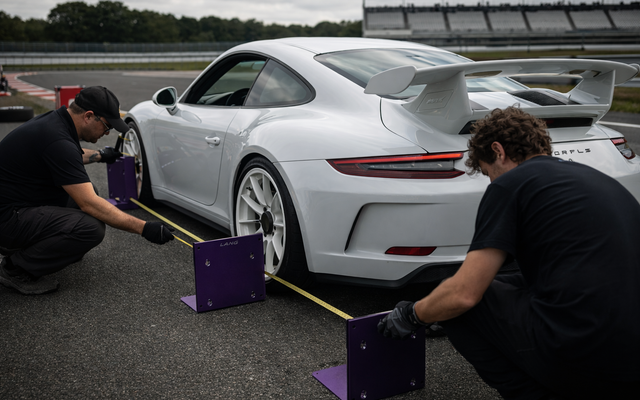
Once the essential components is fitted, the next essential step in the development is the precise adjustment of the car's suspension geometry. This is the realm of car suspension tuning, a methodology that can appear daunting to the beginner but is, in practice, the secret to transforming a assembly of fast parts into a harmonious and predictable whole. The most critical parameter of tuning for oversteer is definitely camber. Camber angle is the inclination of the wheel in relation to the perfectly straight plane when observed from the front-on of the vehicle. If the top edge of the wheel is angled towards the chassis, this is known as camber-in. For drifting, an inward tilt on the front axle wheels is generally applied and is regarded as necessary. The purpose is fundamentally linked to vehicle dynamics.
When a vehicle is going around a bend at limit sideways angles, the chassis rolls towards the external of the bend. This chassis roll makes the outside steering tire to reduce its ideal footprint with the asphalt. By introducing an inward tilt, the wheel is pre-angled to compensate for this tilt. As the car leans into the bend, the outside front tire becomes more upright against the vehicle dynamics tool track, optimizing its traction at the critical point when it is most required for steering authority. Commonly, front adjustments for a serious drift machine fall between approximately -3 degrees to as high as -5 degrees or even beyond, depending on the parameters of the car geometry, tire choice, and pilot style. The rear tires also employ inward tilt, but the values are typically more modest and less aggressive than the front axle. Overly aggressive inward lean at the back can make the car extremely loose and challenging to control on acceleration input, as it shrinks the effective grip area of the driving wheels during forward power delivery. Thus, rear angles are often in the ballpark of -1 degree to -3 degrees, striking a precise compromise between providing sufficient cornering grip to help in starting and sustaining the angle while also preserving good hook-up for power-down the bend. alignment is only one part of the broader suspension geometry equation, which additionally encompasses toe angle, self-centering steering, and steer correction modification.
Toe describes the orientation of the tires when looked at from the top. Toe-in means the leading edges of the wheels are closer together than the trailing edges, while negative toe means the opposite. For sliding, a small amount of front negative toe is often used to quicken the initial steering response, making the car feel more responsive and eager to start a slide. Rear toe angle is usually set to neutral or a incredibly minute amount of positive toe to foster straight-line stability under acceleration. caster angle is the frontwards or rearward inclination of the steering axis when observed from the side-on of the car. More caster angle improves self-centering and high-velocity stability, and it also boosts inward lean increase during steering, which is very useful. Setting these values is a complex dance where a change to a single setting can and will influence the others. The old-school method for dialing in a car's alignment for sliding has long been a labor-intensive endeavor of guesswork and adjustment. A tuner or crew would make a change based on intuition, test the vehicle on track, rely on the driver's subjective sensation and impressions, and then introduce a further change. This loop would continue time after time until the chassis felt "right" or the available track time ended. This approach is not only incredibly inefficient in terms of time and resources, but it is furthermore fundamentally flawed.
Driver perception is a notoriously subjective data source, affected by numerous elements such as fatigue, evolving track surfaces, ambient heat, drift tuning app and simply the mood of the operator on that specific day. What feels "tail-happy" on one lap might feel "understeery" on the subsequent lap, leading to contradictory information and frustrating changes. This age-old limitation in vehicle dynamics optimization is exactly where suspension engineering modern technology has made its mark to revolutionize the methodology.
The rise and application of sophisticated drift telemetry software has brought about a new paradigm for engineering and optimizing professional drift machines. These platforms, showcased by innovative products like GripDial, work by physically capturing the actual physical performance of the vehicle as it is being driven on the track. Unlike depending on subjective feel, these systems collect objective data on key factors such as suspension travel, wheel speed, G-force loading, steering angle, and accelerator and brake pedal position. This raw telemetry is then analyzed by advanced applications that can plot and interpret the information in a actionable way. For the very first time, tuners and crews can visualize precisely what the car is doing at any given point of a drift. This capability changes the entire chassis setup workflow. Imagine the specific challenge of dialing in the front negative camber for a given vehicle. Rather than making a adjustment from -3 degrees to -3.5 degrees and then running multiple runs to try and "sense" a change, a telemetry system can provide real-time and clear feedback. The tool can show visually how the tire's contact patch is behaving during the key stages of a angle: initiation, mid-corner, and switch. It can reveal if the present value is allowing the loaded tire to achieve optimal grip or if the tire is working inefficiently on its outer edge.
The system can after analysis provide data-driven advice for adjustment. Perhaps the information indicates that the outside front tire is even overloading its edge at -3.5 degrees of camber, implying that an increase to angle, say -4 degrees, might be warranted. On the other hand, the information might reveal that the tread is not achieving temperature or that the inner edge is wearing excessively, which could point to that there is excessive negative camber and a slight decrease back to -3.2 degrees would be better optimal. This standard of accuracy and practical analysis was literally unimaginable in the era of exclusively manual tuning.
The benefit of utilizing a dedicated vehicle dynamics tool goes well beyond merely optimizing camber angles. It becomes an essential coilover setup tips that is tailored to your particular car. When setting the shock absorber settings on your suspension, rather than depending on general tips or replicating another team's numbers, you can use the software to see how the car is performing in response to your changes. The application can display the suspension travel path over a section of track, showing if the shocks are handling the body movement optimally or if they are allowing the vehicle to oscillate uncontrollably after a direction change. It can aid in identifying issues like bottoming out or losing droop, allowing you to introduce data-backed adjustments to spring preload, damping settings, or stance. This approach extends similarly to the detailed task of corner balancing. In addition to camber angle, the tool can give data into how changes to toe settings and caster are impacting the vehicle's balance during specific phases of a lap. For example, it can assist you to find the optimal amount of front toe-out for your specific steering configuration and piloting style by analyzing the response time of initial response and the predictability of the car at full lock. This makes the software an incredibly useful vehicle dynamics manual that is constantly informed by the actual dynamics of your personal vehicle on the circuit. It moves the whole endeavor from a mysterious craft into a repeatable development process.
Moreover, the utility of a tool like data acquisition is not at all limited to professional tuners with extensive budgets. For the club-level driver, it serves as an powerful force multiplier. It in essence gives the driver with the analysis of a expert dynamics engineer without requiring the typical overhead. It accelerates the learning curve by giving unambiguous answers to problems that would normally take seasons of trial and error to understand. A tuner can see how their individual car behaves to different settings, gaining a more intuitive knowledge of vehicle dynamics in the endeavor. It furthermore opens up high-level suspension engineering techniques, allowing anyone with the drive to optimize their vehicle to achieve it in a systematic and successful manner. This is notably significant in a activity like sliding, where setup knowledge has traditionally been a highly secretive asset among top crews. In the modern era, that capability can be in the garage of every dedicated driver.
In summary, the path to engineering and optimizing the ultimate championship-contending sliding vehicle is a multi-stage endeavor that seamlessly integrates classic mechanical wisdom with revolutionary telemetry solutions. It begins with the strategic pick of a capable platform, then enhanced by the application of non-negotiable competition parts like maximum-angle angle modification systems and correctly specified drift-spec coilovers. The process then moves into the precision phase of chassis dynamics adjustment, where values like negative camber, toe setting, and caster angle are carefully configured to suit the vehicle's modified capabilities and the operator's individual style. The final step, and what genuinely differentiates the contemporary approach from the past, is the integration of a powerful vehicle dynamics tool. This tool eradicates the uncertainty and inefficiency of solely seat-of-the-pants tuning by delivering objective, real-time information on how the chassis is truly functioning. It acts as an incredible diagnostic aid, a actionable coilover setup manual, and a master vehicle dynamics tool. Together, this complete philosophy ensures that all aspect of the drift car—from the pick of the platform to the last tweak on the coilover—is optimized for ultimate competitiveness on the track. It signifies the full progression of the discipline of drifting, bridging raw car control with data-informed suspension engineering to create the ultimate effective vehicles attainable.